Clinic Medication Inventory: Track Stock Without Losing Money | Medinex
How Malaysian GP clinics can track medication stock accurately and stop losing money to expired or missing inventory.
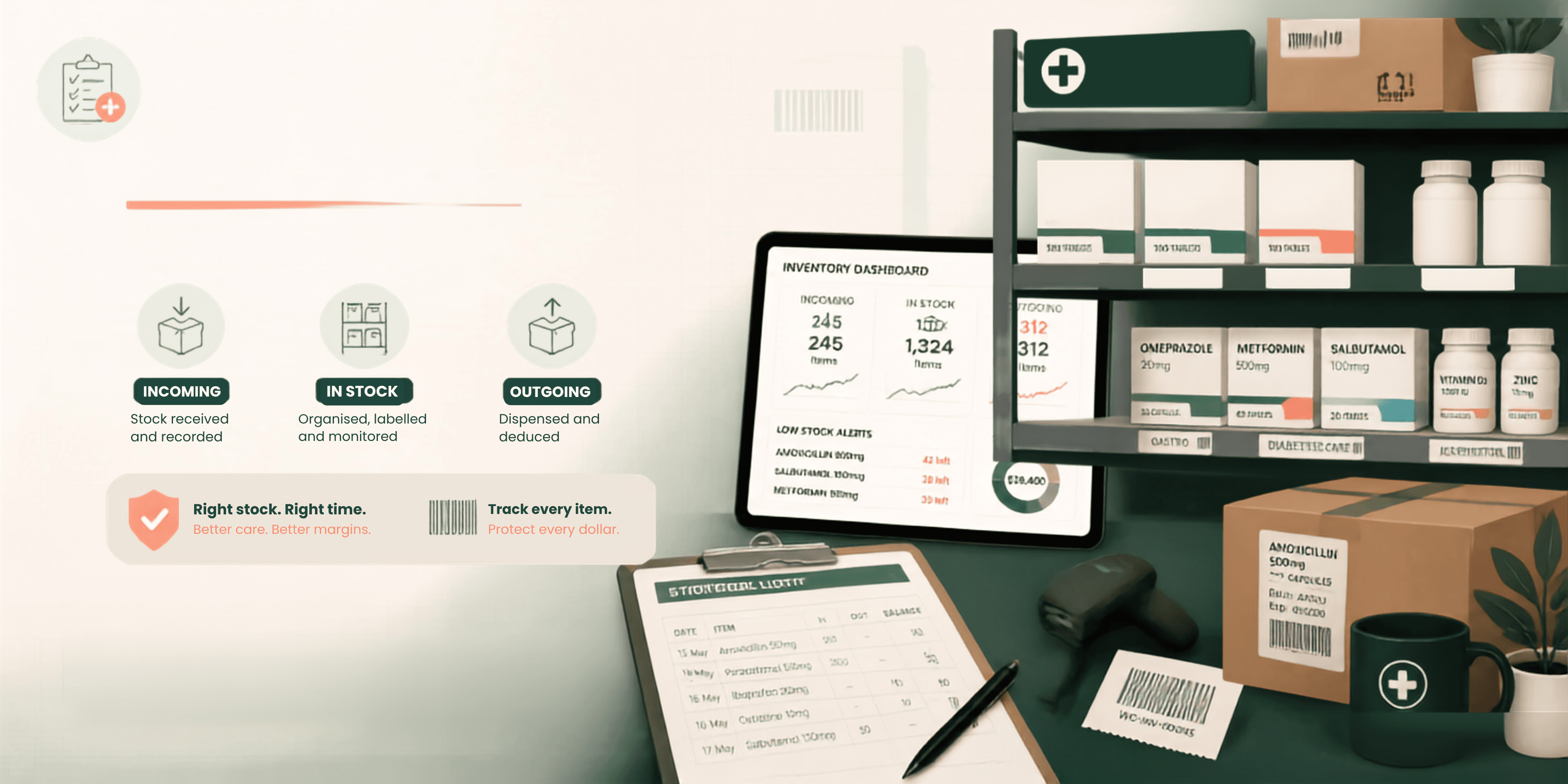
Ask any clinic manager to estimate how much money their clinic loses to medication stock discrepancies each year, and you will typically get one of two answers: “I don’t know” or a figure that, on examination, is significantly understated.
Medication inventory losses in GP clinics come from multiple sources: dispensing without recording, expired stock that was not tracked until it was too late, and in some cases, theft. The aggregate financial impact is substantial. Industry estimates suggest that a typical GP clinic loses between RM 3,000 and RM 8,000 per year to expired medications alone, before accounting for dispensing discrepancies.
This article explains how to set up an inventory management process that prevents these losses.
The Four Sources of Clinic Inventory Loss
1. Dispensing without recording
This is the most common cause of unexplained stock discrepancies. A patient is given one extra tablet because the dose is awkward to package. A medication is dispensed during a rushed consultation and not entered into the system. Over hundreds of consultations, these unrecorded dispensing events accumulate into significant discrepancies.
2. Expired stock not detected until too late
Medications that sit in the dispensary without being used drift toward their expiry date. Without a systematic expiry tracking process, staff do not know a medication is expiring until they happen to look at the box. By then, a significant quantity may be wasted.
3. Returns not tracked
Patients sometimes return unused medications. If returns are not recorded in the inventory system, the stock count becomes inflated, which masks other discrepancies.
4. Theft
A sensitive topic, but a real one. In clinics with poor inventory controls, controlled substances and high-value medications can be diverted without detection. A systematic inventory process acts as a deterrent and enables detection.
Setting Up a Reorder Level System
The most basic inventory management improvement a clinic can make is establishing minimum reorder levels for their core medications. A reorder level is the stock quantity at which you should place a new order to avoid running out before the next delivery arrives.
Calculating a reorder level for each medication:
Determine average daily usage — How many units of this medication do you dispense per day on average? Look at the last 3 months of dispensing records.
Determine your supplier lead time — How many days from order to delivery for this medication? Typically 1–3 days for common medications from local distributors.
Set your reorder level — Average daily usage × (lead time + safety buffer in days)
Example: You dispense an average of 10 tablets of Metformin 500mg per day. Your supplier delivers in 2 days. With a 3-day safety buffer, your reorder level is 10 × (2 + 3) = 50 tablets. When stock falls to 50 tablets, you order more.
For a clinic carrying 60 to 80 active medications, setting up reorder levels for all of them is a one-time effort that prevents the ongoing problem of running out of common medications mid-week.
FEFO: The Right Inventory Method for Medications
Clinic inventory should follow FEFO — First Expiry, First Out. This means the medication that expires soonest should always be dispensed first, regardless of when it was received.
FEFO is the standard for pharmaceutical inventory because medications degrade over time. Using an older batch before it expires and saving the newer batch for later is the only rational approach to minimising expiry waste.
This is different from FIFO (First In, First Out), which is appropriate for food and many other goods where the first item received is the first to be used. In medication inventory, a new delivery of Amlodipine might have a longer expiry than the existing stock. FEFO would have you dispense the existing stock first if it expires sooner, not the new delivery.
In practice, FEFO requires:
Recording the expiry date of every batch received
Physically labelling or organising stock so that shorter-expiry stock is in front
In a digital system: tracking batch expiry dates and automatically flagging the shortest-expiry batch for dispensing
Batch Tracking: Why It Matters Beyond Compliance
Batch tracking means recording, for every dispensing event, which specific batch (batch number and expiry date) the medication came from.
This matters for two reasons:
NPRA drug recalls. The National Pharmaceutical Regulatory Agency (NPRA) periodically recalls medication batches due to quality or safety concerns. When a recall is announced, a clinic with batch tracking can immediately identify which patients received the affected batch and contact them. A clinic without batch tracking cannot.
Stock accuracy. If your total stock count of a medication does not match what the records say should be there, batch tracking helps you identify whether the discrepancy is in a specific batch (suggesting a receiving error) or spread across multiple batches (suggesting ongoing dispensing recording failures).
The Annual Cost of Expiry Waste: A Worked Example
Consider a clinic with 60 active medications:
Scenario | Detail | Cost |
|---|---|---|
5% of stock expires annually | RM 50,000 average annual stock value | RM 2,500 |
8% of stock expires annually | RM 60,000 average annual stock value | RM 4,800 |
12% of stock expires annually | RM 70,000 average annual stock value | RM 8,400 |
A clinic without systematic expiry tracking sits at the higher end of this range. A clinic with FEFO discipline and low-stock alerts that prompt replenishment of slower-moving items can get expiry waste below 3%.
The difference between 12% expiry waste and 3% expiry waste on a RM 60,000 stock value is RM 5,400 per year. For a clinic billing RM 30,000 per month, that is 18 days of revenue wasted on expired stock.
The Audit Trail: What Good Records Look Like
A complete inventory audit trail for a single medication should show:
Opening stock balance (quantity on hand at start of period)
Every receive-in event (date, supplier, batch number, expiry date, quantity received)
Every dispense event (date, patient, consultation reference, quantity dispensed, batch number)
Every adjustment (wastage, breakage, return, correction) with reason and authorised by whom
Closing stock balance
At any point, you should be able to look at the current stock count and reconcile it back to every movement that produced it. If you cannot, there is a gap in your records.
→ Medinex auto-deducts dispensed quantities from inventory at point of dispense and tracks batch numbers and expiry dates. Book a demo to see the inventory management workflow.


