How Panel Billing Works at Malaysian GP Clinics | Medinex
Panel billing guide
If you have recently opened a GP clinic in Malaysia, or taken over an existing practice, one of the first operational realities you will encounter is panel billing. A significant proportion of your patients will walk in with a company medical card rather than paying cash — and the process of getting paid for those consultations is fundamentally different from a cash transaction.
This guide explains how panel billing works from the ground up: what a TPA is, how the cashless process flows, who the main players are, how and when you get paid, and what the financial risks of a poorly managed panel billing operation look like.
What Is a Panel Clinic?
A panel clinic is a GP clinic that has entered into an agreement with one or more Third Party Administrators (TPAs) to provide cashless medical treatment to employees of companies that hold group medical insurance policies administered by that TPA.
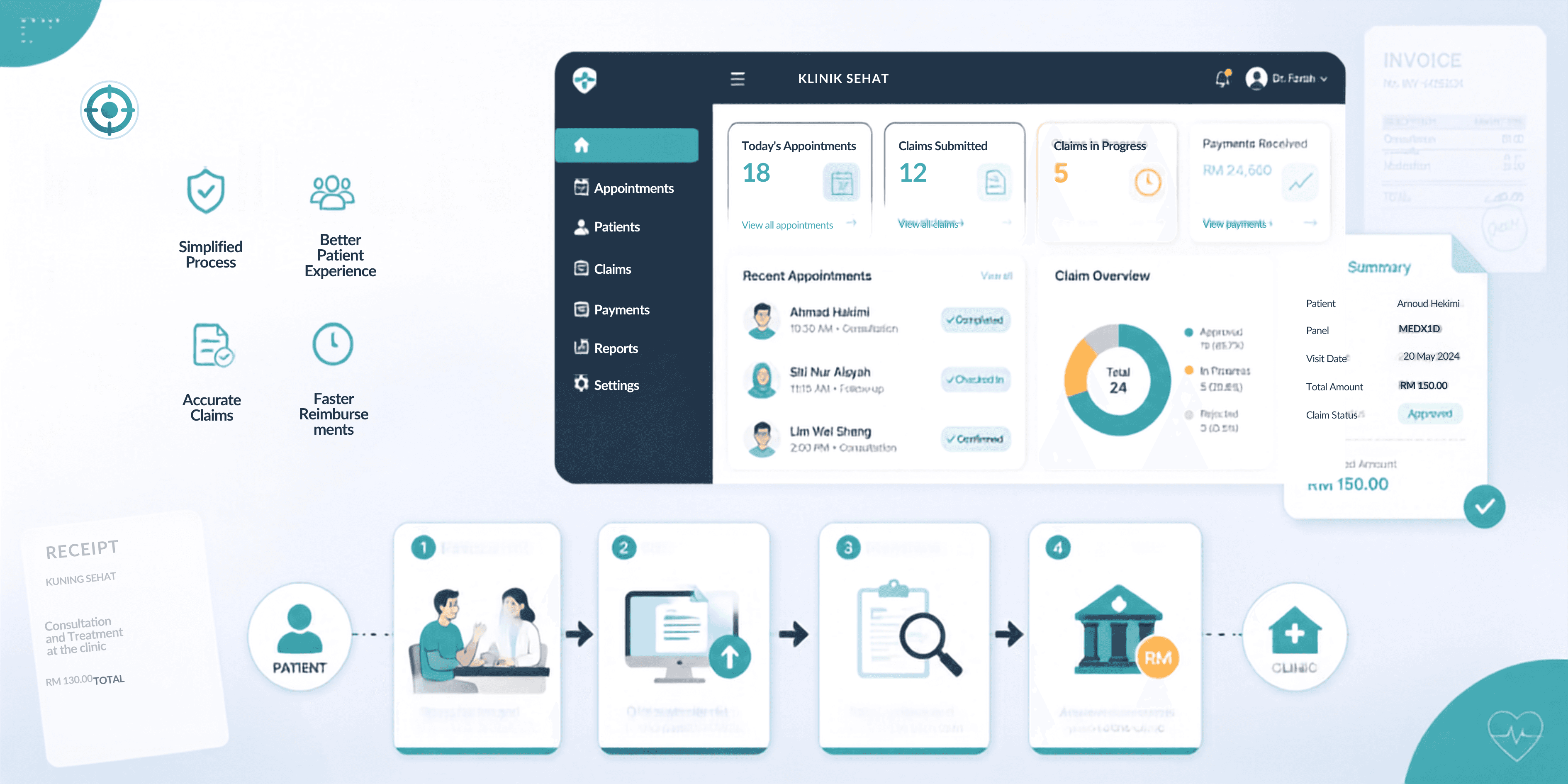
Here is the simplified flow: A large company (say, a bank or a manufacturing company) takes out a group medical insurance policy for their employees. The insurance company appoints a TPA to manage the claims and administer the benefits. The TPA builds a network of clinics (called panel clinics) that agree to see the company’s employees on cashless terms. When an employee needs to see a doctor, they go to any clinic in the panel network, receive treatment without paying upfront (except for a co-pay if applicable), and the TPA settles the bill with the clinic afterward.
For clinic owners, panel patients represent a reliable revenue stream — but one that comes with specific administrative requirements and, if managed poorly, significant cash flow risk.
The Main TPAs in Malaysia
Several TPAs operate in Malaysia and each has their own portal, claim format, and payment processes. The main ones you will encounter as a GP clinic:
HealthMetrics — One of the largest digital TPAs in Malaysia. Operates a cloud-based platform. Claims submitted via their portal or API. Known for relatively clear rejection feedback.
MediExpress (Medix) — Significant TPA with a large corporate client base. Has their own portal and CSV-based claim submission format. Payment cycles tend to be monthly.
PMCare — MOH-affiliated TPA historically used for government-sector employees. Has its own claim system and member card verification process.
MediLink-Global — A long-established TPA with over 2,000 healthcare provider network. Uses their Electronic Claims Clearing System (ECCS) for digital claim submission.
Integrated Health Plans (IHP) — Operates a panel network for specific corporate clients. Claims submitted through their portal.
PMCare, IHM, CompuMed, MiCare — Smaller TPAs with specific corporate client bases. Operational processes similar to above.
Most active GP clinics are panelled with multiple TPAs simultaneously. Managing claims across different portals with different formats is one of the primary administrative challenges of panel billing.
The Cashless Consultation Flow: Step by Step
Here is what happens from the moment a panel patient walks into your clinic:
Step 1: Patient presents their medical card
The patient shows their corporate medical card (physical or digital) at the front desk. The card contains their member ID, employer details, and the TPA they are covered under.
Step 2: Eligibility verification
Your front desk verifies that the patient is an active member with valid coverage. This can be done via the TPA’s portal (live check), by calling the TPA hotline, or in some cases through a system integration. Skipping this step is a common source of claim rejections later.
Step 3: Consultation and treatment
The doctor sees the patient normally. Medications dispensed, procedures performed, and investigations ordered are recorded. The nature of the visit is documented using the relevant diagnosis codes.
Step 4: Invoice generated with panel split
Your billing system generates an invoice showing:
The total value of the consultation (consultation fee + medications + procedures)
The portion covered by the TPA (based on the patient’s plan benefits)
The patient’s co-pay amount, if any
Step 5: Co-pay collected at the counter
The patient pays their co-pay (if applicable) before leaving. This is typically a fixed amount (e.g., RM 10 or RM 15) defined by their corporate plan.
Step 6: Claim submitted to the TPA
Your clinic submits the claim to the TPA for the covered portion. This is done through the TPA’s portal or via a structured file export from your billing system. The claim includes the invoice, diagnosis codes, and treatment details.
Step 7: TPA reviews and settles
The TPA reviews the claim, verifies it against the patient’s benefits, and approves or rejects it. Approved claims are batched and settled to your clinic via bank transfer, typically monthly.
Payment Cycles: How Long Until You Get Paid?
Payment timelines vary by TPA, but the typical cycle for a GP clinic is:
Claim submission deadline: Usually end of the month, or within 30 days of the consultation
TPA review period: 14 to 30 days after submission
Settlement: Bank transfer, typically within 30 to 45 days of claim submission
In practice, this means you are providing services in one month and receiving payment for them in the following month or later. For a clinic with high panel volumes, this creates a working capital gap that needs to be managed.
A clinic billing RM 20,000 per month in panel claims may have RM 40,000 to RM 60,000 outstanding in the TPA payment pipeline at any given time. Late payments from TPAs are common and add further pressure on cash flow.
The Cost of a Poor Rejection Rate
Claim rejections are the silent cash flow killer for panel-heavy clinics. When a TPA rejects a claim, you either lose the revenue or invest additional staff time in investigating and resubmitting.
Consider the economics:
Clinic profile | Panel claims/month | 5% rejection rate | Lost revenue if not recovered |
|---|---|---|---|
Small (30 patients/day, 40% panel) | ~250 claims | 12–13 rejections | ~RM 625–RM 875 |
Medium (60 patients/day, 50% panel) | ~650 claims | 32–33 rejections | ~RM 1,600–RM 2,300 |
Busy (80 patients/day, 60% panel) | ~1,000 claims | 50 rejections | ~RM 2,500–RM 3,500 |
These numbers assume an average claim value of RM 50. A 5% rejection rate is common for clinics without a structured pre-submission check process. Getting rejection rates below 2% is achievable with the right workflow and is worth thousands of ringgit per month.
What Makes Panel Billing Administratively Hard
If panel billing was simple, every clinic would manage it effortlessly. The reality is that it has several characteristics that make it administratively demanding:
Multiple TPAs, multiple formats. HealthMetrics has a different claim format from MediExpress, which has a different format from PMCare. If you are panelled with four TPAs, you need to manage four different claim submission workflows.
Eligibility verification is manual. Unless your CMS integrates directly with TPA eligibility systems, checking whether a patient is covered requires logging into a portal or calling a hotline. This adds time to every panel check-in.
Rejection codes are cryptic. TPAs return rejection codes that are often abbreviations or numeric codes. Understanding what each code means, and how to fix the underlying issue, requires experience.
Cash flow timing mismatch. You provide the service, incur the cost of medications and staff time, and wait 30 to 60 days to be paid. This gap requires active cash flow management.
How a Good Clinic Management System Helps
The right CMS addresses the structural challenges of panel billing:
Auto-detects panel coverage at check-in from the patient’s NRIC or member card, without requiring the front desk to manually look up TPA details
Calculates co-pay split automatically based on the patient’s plan
Generates claim files in the format each TPA requires, without manual reformatting
Tracks claim status (submitted, pending, approved, rejected) for every panel claim
Surfaces rejection codes with plain-language explanations so staff can fix and resubmit efficiently
Reconciles TPA payments against submitted claims to identify outstanding amounts
→ See how Medinex handles panel billing end-to-end. Book a demo.